



Dispatch from the Field, 11/04/26
November 4, 2026
Hello you marvelous rascals! It has been almost two months since my last dispatch from the field. As you've been out there evolving microbes, designing wetlands and whatever else you smart hot people are doing, I've been working on the Field Guide. We're up to five posts now, the most recent being on attention and focus in the age of AI. As you know, I've built a number of little organizational tools to help me cope with the literature reviews and epistemic cartographyew, gross, I know, I cringed when I wrote it involved. And, because I think literally one of you have told me that my progress updates are interesting, I thought it was time to catch you up.
Tabs tabs tabbity tab tabs
Ok, I can't tell if this is embarrassing or not, but I wrote the last Guide post primarily through the power of tabs. I know. I know. We're BACK TO THE QUEUE!!!!!!
But look, in between the last post and this most recent one, something changed: I laid out the itinerary for the Field Guide. That meant that I did much less scope negotiation for the post on designing for attention than I did for previous posts. Also, I had clearer keywords"Theories about human-machine dyads" wasn't the catchiest with which to navigate the pre-LLM literature. As a result, I didn't lean as heavily on spatial organization, and I didn't even use the Guide's much-vaunted...well, I vaunt ontology-based scouting feature. I just used Google Scholar and a couple of LLMs to extend my searches.
To organize the results, I went back to InfoBoard, the canvas that lets me paste links as cards with notes, color coding and emojis. The one that, if you recall, I scorned in Demo Time back in July.I hate to say it, but I haven't used the fancier drawing-enabled tool from Demo Time at all since the summer. What I have used is the simpler spatial organizational tool that is basically Obsidian Canvas. I used InfoBoard to triage the information I was finding into two types of categories: Subject, e.g., attention, memory, prototypes, review papers; and relevance, i.e., write about this now or write about this later. The subject categories on the InfoBoard acted as anchor points for sections of the Guide post. I then used browser tabs to organize the relevant papers in chronological order, i.e., the order in which I would cite them in the Guide post. I did iterate and expand on the tabs, sending LLMs out to scope new areas and track down relevant work; but I tended to consolidate back into the chronological scheme pretty regularly.
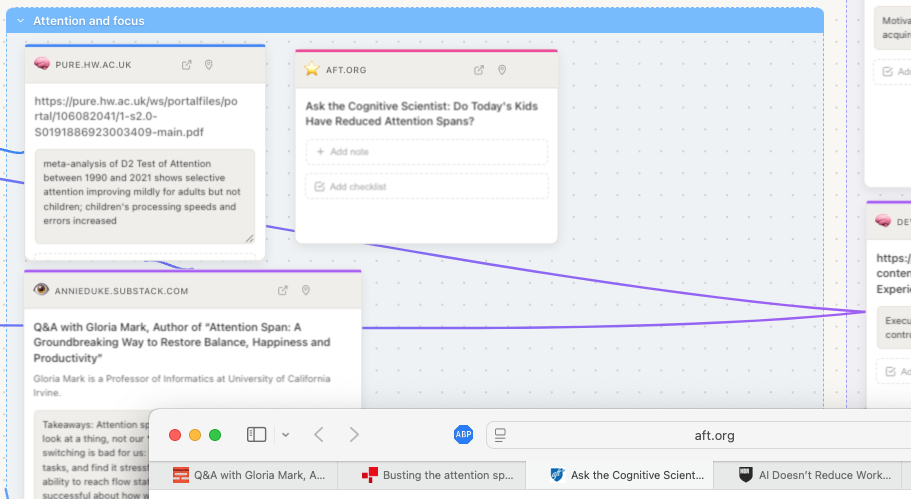
This experience has validated a hunch I've had for a while, which is that the tools you need for knowledge work change as the project progresses.DUH. Duh, right? Duh. The Allegra who started the Guide had no idea where it was going to go and had read barely any of the relevant literature. As a result I needed to use every spatial, color-coded, ontological organizational power at my fingertips. Today I have my work cut out for me. I've learned that most of my job is drawing lines between a) established areas of study that inevitably have high-quality review papers and b) work with and about LLMs, which has not had much time to accumulate. So I don't need quite as much structure, and sometimes a queue will do.
Repo at your own risk
That said, I won't throw my other tools in the trash, because you never know when you'll be back in the metaphorical woods.I am, after all, a babe In fact, I've dusted them all off and put them in public repos on Github. I've even rewritten (some of) the readmes to banish (some of) the Claudish. In case you're interested,Well, a couple of people were interested, which is why I did this the following are now available:
- InfoBoard, which I found out later is basically Obsidian CanvasSide note, Obsidian Canvas looks much more functional, so, like, maybe use that one?
- The "drawing is thinking" canvas from Demo Time (called "house", because it has houses)
- The Guide's curator interface
- And something goofy y'all haven't seen before: Narrative watersheds.
Narrative watersheds is a silly/bad iteration of a silly/good idea that's been bonking around my head for a year or so now. It goes back to that progression of expertise across a project. When you first start out learning about something, you don't even know what the landscape looks like. You sketch out your general heading ("thinking for ourselves"), and then you start filling in spaces one by one ("vocabulary, neurorights, theory, education, attention...") And you start forming your own arguments that draw on and further other people's work. I've always wanted a way to visualize this exploration. So I built this narrative watersheds tool that tries to draw the flow of ideas through an essay as if they were tributaries joining a river.The name is my husband's idea and it is as brilliant as he is (very brilliant) The execution is extremely weak right now, just the worst-looking thing, and it all hinges on clustering, which you know I have beef with – but I still like the idea, especially when you think of it less as a screen-based productivity tool and more as a beautifully drawn, contemplative map hanging on your wall. I'll circle back to it eventually, and in the meantime maybe some of you clever folks can improve upon it.
But now for something completely different!
Google will just rewrite your writing if it feels like it
As some of you might know, I have been trying to boost readership of the Guide, in part because I think a lot of people are interested in cognitive agency right now but also because I will get more funding if more people read it. That has led me to the noxious/obnoxious world of Search Engine Optimization, and the somewhat sheepish experience of Googling myself.;) Now, there's an alternative Allegra Cohen who has twenty or so years on me and takes up most of the search results, but I'm pleased to report that if you Google "allegra cohen ai" you get mostly hits for my work.
And some of those hits have been rewritten.
Take, for example, this screenshot of the LinkedIn post that I made for the Guide's AI in Education article:
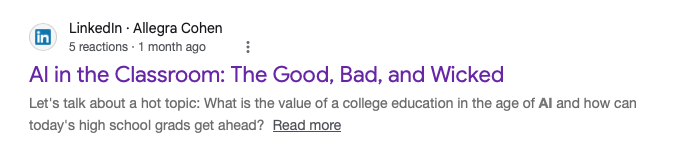
Does that sound like me? Would I ever write a title like that?Actually I did consider a title like that BUT THEN I DECIDED AGAINST IT Does the LinkedIn post or article itself have anything to do with the "value of a college education in the age of AI" or "how today's high school grads can get ahead"?
NO!!!!
No!
NOT EVEN A LITTLE BIT!!
I did not get hacked; LinkedIn didn't rewrite my post through some secret AI assistance program. THIS IS JUST A THING GOOGLE DOES. One study in 2020 found that Google rewrites what appears in search results around 70% of the time. Now, this is ostensibly because it helps users better find what they're looking for, and they basically say, "If you don't want this to happen, write better meta tags." But I don't have control over LinkedIn's meta tags! My only option to fix that result is to submit feedback. So I did that, and now the search result has a) the same incorrect title and b) summary text that is just incorrect in a different way.
At this point let me acknowledge that this probably doesn't bother the vast majority of people writing and reading on the Internet. On the contrary, I imagine folks are happy that Google is trying to get more people to their sites. But to me it seems like nothing less than the MASS HOMOGENIZATION AND CENSORSHIP OF THE ONLINE PUBLIC!!1! It's bad enough that Claudish and GPTlish jam unasked-for rhetorical frameworks into every part of our lives,"It's not X, it's Y." DON'T TELL ME WHAT MY OPTIONS ARE without every unique and human-written piece of text then being ground down and extruded into perky SEO-compliant SLOP!!!!!
Ok, I'm done yelling.
Anyways.
As you can see, I'm learning a lot about the world of outreach and publicity.send help I sort of doubt this type of rant will make a regular appearance here on See What U Think, but I was slightly surprised that Google rewrites text so regularly and even more slightly surprised that I couldn't find other rants about it. So I thought I'd bring it up.
In any case, enjoy the repos, and I'll see y'all on the flipside :)