





The future I want
April 15, 2026
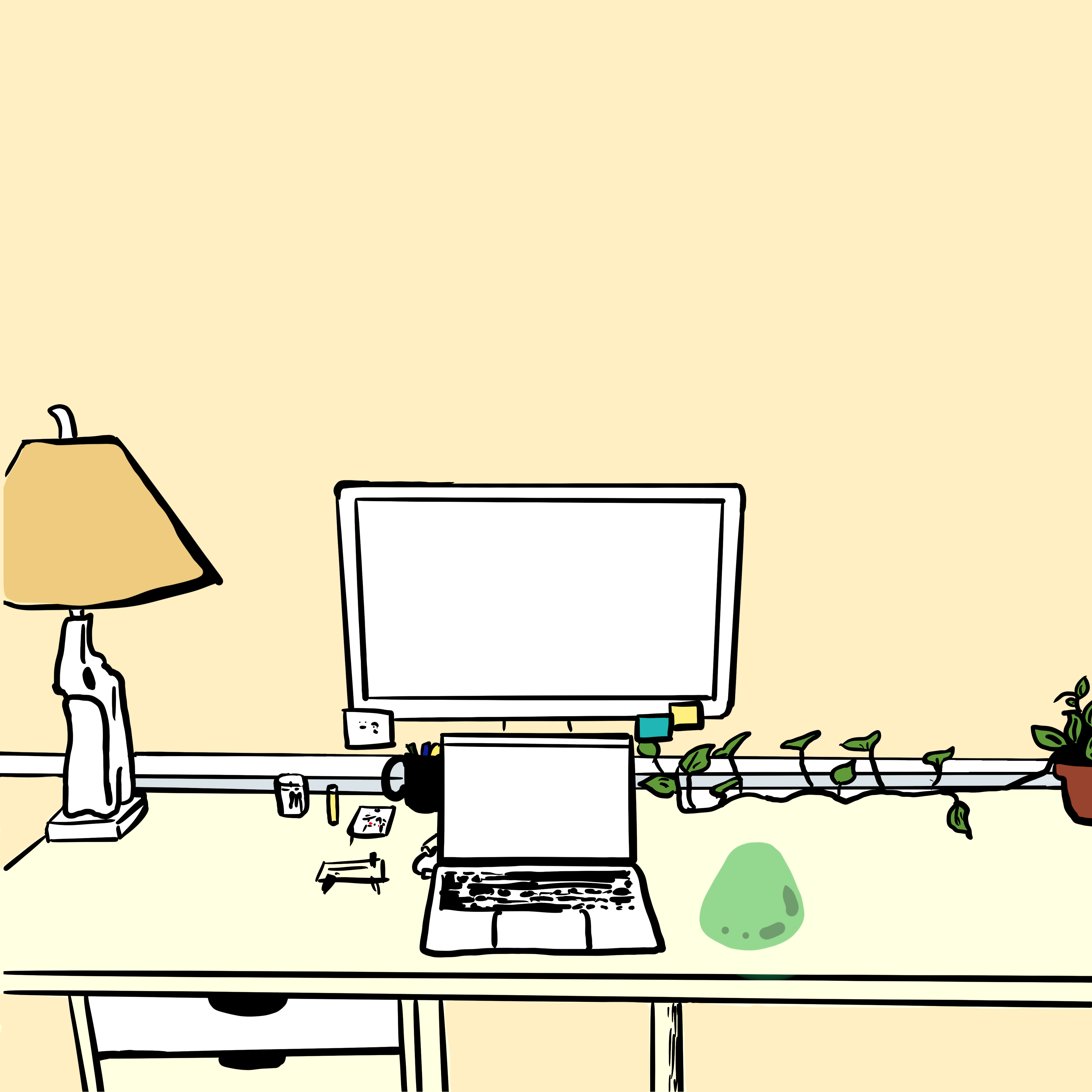
Pretend you're reading a Gibson novel for a second and join me in my office. I have a laptop, a monitor and a desk, just like most people who do knowledge work. I also have a thing that looks like a gumdrop.
I put my gumdrop on the desk and it lights up. Stacked around us are books with titles and summaries that appear when we direct our gaze towards them. These are memory cues for things I've been working on. Most are in good shape, but a few are dusty and tattered, letting me know I haven't visited them in a while.0. Siyi Zhu and Joel Chan. "Sense and Senseability: Exploring Future Immersive Environments for Scholarly Sensemaking." Creativity & Cognition 2025, June 23 - 25. I toss one of the books onto my monitor so we can look at an essay I'm writing.
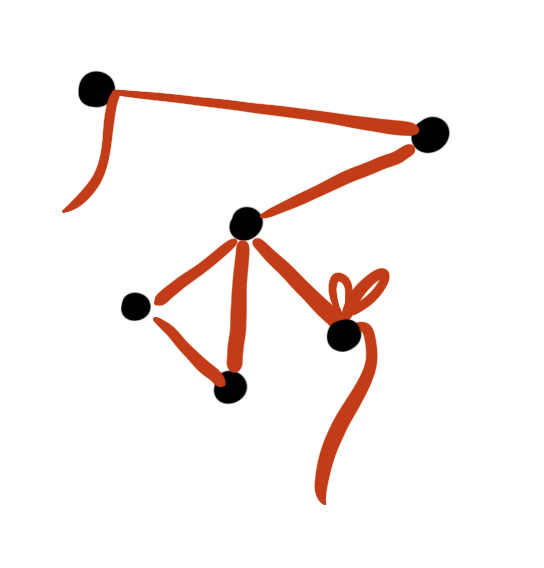
I'm trying to explain to you what I think my starting point should be, but I haven't finished the section yet. As we peer at the text, you grab a few sentences and put them in the air beside us. My AI assistant, driving the gumdrop, doodles a few possible connective paths between sentences. One of them rankles me for reasons I can't explain yet, so I move the two sentences far apart and the path dissolves into mist.
As we talk, the gumdrop helps us do things that the chat interface on my screen does not. At various points in the conversation:
- I hold a thought, literally, by placing it in the air where we can see it.
- We jump levels of abstraction fluidly. The gumdrop provides a fisheye lens on text, allowing us to abstract entire paragraphs ("your point here") with one hand while scrutinizing sentences ("see, I wouldn't use that word") with the other.0. Amelia Wattenberger. "Fish Eyes."
- The gumdrop also helps us define analogies that we can use to abstract whole trains of thought. At some point we're pointing to an icon instead of rehashing a sub-argument.
- We talk about things without having to name them yet. "Whatever you want to call that" is a cluster of pink and purple hovering above the lamp, not a term that must be negotiated and defined before we can proceed.
- My AI assistant helpfully chunks and visualizes information, adding text, icons and colors in a way that minimizes our cognitive load. We correct it with the flick of a wrist when necessary.
We choose the direction, the organization, the pace and the abstraction of the conversation. We exercise cognitive skills in doing so, but we're not overwhelmed by the complexity of the topic or frustrated by the fuzziness of some of my early ideas. The visuals help strengthen our knowledge schema and provide a tangible medium with which we can work before we're ready to write things down. My AI assistant is a helpful conversation partner, but the session is about you and me working through ideas, so it stays in the background.
After we're done, you head back to wherever you're reading this and I return to my desk to tidy up. I don't have a lot of time, so I bring my AI assistant in. "Can you rewrite the essay outline to match what we talked about?" I ask it. It turns out that an entire concept I've spent quite a bit of time learning about is more of a detour than a throughline. My AI assistant asks me what I want to do with the jumbled set of sentences and notes, and I say I want to keep them. Next time I take out the gumdrop, there's another little book on my desk.